

- Summary
- Introduction
- From Verbatim Data to Standardized Medical Coding
- AI Medical Coding vs Traditional Auto-Coding
- How AI Medical Coding Works, Step by Step
- Where Human Medical Coders Still Matter
- AI Medical Coding Examples: MedDRA and WHODrug
- What Makes AI Medical Coding Reliable in Clinical Trials?
- Where AI Creates Operational Value in Medical Coding
- What Sponsors and CROs Should Evaluate in AI Medical Coding Software
- Conclusion
- External References
Summary
AI-assisted medical coding in clinical trials converts site-entered verbatim terms into standardized MedDRA or WHODrug terminology. It combines existing dictionary matching with language interpretation, candidate ranking, confidence-based routing, and medical coder review to make clinical trial coding faster while keeping decisions controlled and traceable.
Introduction
Clinical trial data rarely enters a system in standardized language. An adverse event may be recorded as “severe headache,” “throbbing pain in head,” or “head pounding,” while medications may be entered using brand names, abbreviations, or misspellings. Before this data can be consistently reviewed and analyzed, verbatim terms must be mapped to standardized terminology such as MedDRA and WHODrug.
Traditional medical coding uses dictionary searches, exact matches, synonym lists, coding conventions, and coder review. AI-assisted medical coding adds an interpretation layer by normalizing language, identifying likely clinical concepts, ranking possible matches, and routing ambiguous terms for review or clarification.
The goal is not to replace medical coding judgment, but to move from site-entered verbatim data to consistent, traceable coded data more efficiently.
From Verbatim Data to Standardized Medical Coding
A verbatim is the original clinical information recorded by an investigator or site. Depending on the study, this may include adverse events, medical history, concomitant medications, indications, and other codable clinical information.
The challenge is that investigators do not necessarily describe the same concept in the same way.
For example:
- Headache
- Head pounding
- Severe pain in head
- Throbbing headache
Leaving these entries only as free text would make it difficult to consistently group and evaluate the same clinical concept across hundreds or thousands of subjects.
Medical coding provides that standardization.
Site-entered verbatim → Medical coding → Standardized terminology → Review and analysis
Importantly, coding does not mean replacing the original information. The original verbatim remains traceable alongside the coded information. FDA study-data guidance, for example, describes the importance of providing both collected verbatim terms and coded terms in electronic study data submissions.
The terminology used depends on what is being coded, which is where MedDRA and WHODrug enter the workflow.
Clinical trial medical coding relies on standardized dictionaries depending on the type of data being coded.
MedDRA is commonly used for adverse events, medical history, and other medical concepts. A reported term is mapped to an appropriate Lowest Level Term (LLT), which connects to a Preferred Term (PT) and the broader MedDRA hierarchy.
WHODrug is used for medications. It helps standardize entries that may be reported using brand names, generic names, spelling variations, or different product descriptions.
AI Medical Coding vs Traditional Auto-Coding
Traditional auto-coding is effective when a verbatim term already has a clear dictionary match, validated synonym, or predefined coding rule. It works well for straightforward and previously known terms where little interpretation is required.
AI medical coding extends this process by helping interpret terms that do not match cleanly. It can account for spelling variations, abbreviations, synonyms, contextual clues, and semantic similarity, then identify and rank the most relevant MedDRA or WHODrug candidates.
The key difference is not that traditional systems cannot automate coding. It is that AI can support the interpretation of less straightforward verbatim terms and help determine the most relevant coding options when exact matching is not enough.
| Traditional Auto-Coding | AI Medical Coding |
| Relies mainly on exact matches, synonyms, and predefined rules | Can interpret broader linguistic and contextual variation |
| Works best for known and straightforward terms | Helps with terms that do not match cleanly |
| Uses largely deterministic matching logic | Can use NLP, machine learning, and semantic interpretation |
| Often produces a direct match or no match | Can surface and rank multiple relevant candidates |
| Unmatched terms may require manual dictionary searching | Can narrow the search to the most likely MedDRA or WHODrug options |
| Limited use of context | Can use available context to support candidate selection |
| Automation is strongest for predictable cases | Automation can extend to more complex coding scenarios, subject to confidence and review rules |
In simple terms:
Traditional auto-coding identifies known matches.
AI medical coding helps interpret less straightforward terms and identify the most relevant coding candidates.
This distinction becomes clearer when we look at how AI medical coding works across the coding workflow.
The Future of Medical Coding with AI and ML
Explore how AI and machine learning are changing clinical trial medical coding through faster term standardization, coding suggestions, review support, and improved consistency.
How AI Medical Coding Works, Step by Step
AI medical coding works across the coding workflow, but its role is not identical at every stage. Some steps rely on structured rules and dictionary logic, while others use NLP, machine learning, or semantic interpretation to understand the verbatim and identify the most relevant coding candidates.
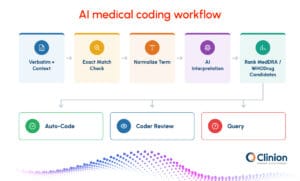
Together, these capabilities create a workflow that can handle straightforward matches efficiently while applying deeper interpretation when the reported term is less clear.
Step 1. Identify the Verbatim and Coding Context
The process begins by identifying both the source term and the context in which it was entered. The system may already know from the EDC field whether the entry represents:
- An adverse event
- A medical history condition
- A concomitant medication
- An indication
This context helps determine which coding dictionary and rules should apply.
Step 2. Check Exact and Existing Matches
The system first looks for reliable matches using available dictionary terms, validated synonyms, previously accepted mappings, and established coding rules.
If a clear match already exists, the term can move forward without unnecessary deeper interpretation.
Step 3. Normalize Unmatched Terms
When a verbatim does not match cleanly, the workflow may normalize the language before deeper interpretation. Depending on the system, this can involve predefined rules, NLP, AI, or a combination of these approaches.
Normalization can address:
- Misspellings
- Abbreviations
- Capitalization differences
- Word-order variations
- Synonyms
- Other linguistic variations
The purpose is to reduce language differences that may prevent a reliable match, while preserving the clinical meaning of the original verbatim.
Step 4. Interpret the Clinical Meaning with AI
For terms that remain unclear after normalization, AI can evaluate the wording and available context to identify the likely underlying clinical concept.
For example: “Throbbing pain in head” can be interpreted as a complete clinical expression rather than matched only word-for-word against dictionary terms.
For medication coding, other available context may also help distinguish between possible medicinal product matches.
Step 5. Search and Rank Relevant Dictionary Candidates
Once the likely concept has been identified, the system searches the relevant MedDRA or WHODrug terminology and ranks potential matches based on relevance or confidence.
For example:
Candidate 1: Most likely match
Candidate 2: Alternative interpretation
Candidate 3: Less likely match
This reduces the amount of manual dictionary searching required and helps direct coder attention toward the most relevant options.
Step 6. Decide What Happens Next
Identifying a candidate does not necessarily mean the coding process is complete. The next action depends on how clear the match is and whether the available source information supports it.
AI Medical Coding Workflow: Auto-Code, Review, or Query?
AI-assisted coding should not treat every suggestion the same way. The output needs to be routed based on confidence, clarity, and whether the verbatim contains enough information for a reliable coding decision.
Clear match
Auto-Code: A clear, high-confidence match that meets predefined coding rules may move forward automatically.
Likely match
Route to Coder: A likely match exists, but medical coding judgment is required before it is accepted.
Insufficient information
Query the Site or Source: The verbatim itself does not contain enough information to support a reliable coding decision.
For example, a verbatim such as “heart problem” is too broad to identify a specific medical condition with confidence. AI may surface possible interpretations, but choosing one would introduce information that was not provided in the source.
In such cases, the correct next step is clarification rather than forcing a coding decision.
Where Human Medical Coders Still Matter
AI can reduce searching and help prioritize likely candidates, but ambiguous clinical language still requires coding judgment.
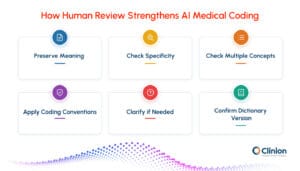
A medical coder may need to determine:
- Whether the proposed term accurately preserves the verbatim meaning
- Whether the suggestion introduces information that was not reported
- Whether the proposed level of specificity is justified
- Whether the verbatim contains more than one medical concept
- Whether study-specific coding conventions have been followed
- Whether further clarification is required
- Whether the correct dictionary and version are being used
This is particularly important when the original information is incomplete.
For example, selecting a specific diagnosis when the site has reported only symptoms can alter the clinical meaning of the source information. MedDRA term-selection guidance explicitly cautions users not to add information that was not reported.
Human review is therefore not a failure of automation. It is one of the controls that allows AI to be used without turning an uncertain prediction into an unsupported coding decision.
AI Medical Coding Examples: MedDRA and WHODrug
Looking at the complete path makes the distinction between simple matching and AI-assisted coding clearer.
How AI Medical Coding Works Across MedDRA and WHODrug
The same AI-assisted coding workflow can behave differently depending on whether the site-entered term relates to an adverse event or a medication.
Consider the verbatim: “Throbbing pain in head”
- Original verbatim: Throbbing pain in head
- Coding context: The term was entered as an adverse event.
- Existing-match check: No reliable direct match is found.
- Normalization and interpretation: The system evaluates the expression and identifies a likely headache-related concept.
- MedDRA search: Relevant LLT candidates are retrieved and ranked.
- Coding decision: The highest-ranked appropriate candidate is confirmed by the coding workflow or reviewed by a coder.
- Standardized output: The selected LLT is linked to its corresponding Preferred Term and higher levels of the MedDRA hierarchy.
The original “throbbing pain in head” entry remains available for traceability.
Now consider: “Tylenol taken for fever”
- Original medication entry: Tylenol
- Coding context: Concomitant medication.
- Normalization: The product name and available supporting information are evaluated.
- WHODrug search: Relevant medicinal product candidates are identified.
- Contextual comparison: Available details such as ingredient, indication, dose, route, country, or formulation can help distinguish possible matches where relevant and available.
- Coding decision: The appropriate WHODrug record is selected or routed for review.
- Standardized output: The medication is represented using standardized medicinal product information instead of relying only on the site-entered brand name.
Key point: These examples also show why AI medical coding is more than text replacement. It combines source context, terminology search, interpretation, and controlled decision-making.
What Makes AI Medical Coding Reliable in Clinical Trials?
Human oversight remains an important part of AI medical coding, particularly for ambiguous or complex terms. Alongside human review, the workflow also needs controls that keep AI recommendations consistent, traceable, and appropriately managed throughout the study.
Confidence-Based Routing
Not every AI suggestion should be treated the same way. High-confidence matches may be eligible for greater automation, while lower-confidence terms should be routed for coder review or clarification based on predefined rules.
Coding Decision Traceability
The workflow should preserve a clear link between the original verbatim, the AI-generated recommendation, the coder decision, and the final coded term. This makes it possible to understand how a coding decision was reached.
Controlled Dictionary and Version Management
AI recommendations must be generated against the correct MedDRA or WHODrug version. When dictionaries are updated, previously coded terms may need to be reassessed or recoded, with any changes remaining traceable.
Audit Trail for Coding Decisions
Changes to coding decisions, coder overrides, approvals, and recoding activities should be recorded so that the history of the coding process can be reviewed when needed.
Validated Coding Workflow
AI should operate within a controlled and validated coding process, with defined rules for how recommendations are generated, reviewed, accepted, or escalated.
Data Security and Access Control
Because medical coding uses clinical trial data, appropriate access controls, privacy safeguards, and security measures should apply throughout the workflow.
Together, these controls ensure that AI does not simply generate coding suggestions, but supports a workflow in which those suggestions can be consistently reviewed, governed, and traced.
Where AI Creates Operational Value in Medical Coding
The operational value of AI medical coding comes from changing how coding work is distributed. Instead of medical coders spending the same level of effort on every verbatim, the workflow can separate straightforward terms from those that genuinely require interpretation.
This can help teams:
- Move clear and high-confidence terms through coding faster
- Reduce manual dictionary searching for unmatched terms
- Bring ambiguous or incomplete verbatims to attention earlier
- Direct coder effort toward lower-confidence and clinically complex cases
- Maintain coding more continuously as study data is collected
- Reduce the volume of unresolved coding work accumulating later in the study
The result is not simply more automation. It is a coding workflow in which human effort is concentrated where medical judgment provides the most value.
What Sponsors and CROs Should Evaluate in AI Medical Coding Software
When evaluating AI medical coding software, sponsors and CROs should look beyond whether the system can simply suggest a code. The more important question is how well the complete coding workflow is controlled, reviewed, and connected to the underlying clinical data.
Key areas to evaluate include:
- Dictionary support: Does the system support the required MedDRA and WHODrug dictionaries and versions?
- Matching logic: Can users distinguish exact matches, synonym-based matches, and AI-generated recommendations?
- Confidence handling: How are confidence or relevance scores used to determine whether a term is auto-coded or routed for review?
- Coder review: Can medical coders easily view, confirm, change, or reject suggested terms?
- Alternative candidates: Does the system surface other relevant coding options when the top suggestion is uncertain?
- Query management: Can ambiguous or incomplete source information be queried directly from the coding workflow?
- Dictionary versioning: How are updates, up-versioning, and recoding handled?
- Traceability: Can the original verbatim, AI recommendation, coder decision, and final coded term be followed through the workflow?
- Audit trail: Are overrides, approvals, and subsequent coding changes recorded?
- EDC integration: Does coding remain connected to the source record, or does it require separate exports, transfers, and reconciliation?
- Source-data changes: What happens if the underlying clinical data changes after a term has already been coded?
The strongest AI medical coding systems are therefore not defined only by how quickly they generate suggestions, but by how reliably those suggestions can move through a controlled clinical trial coding workflow.
AI in Clinical Trials: Accelerating Timelines and Reducing Costs
Explore how AI supports faster clinical trial workflows, improved data review, smarter monitoring, reduced manual effort, and more efficient study execution.
Conclusion
AI medical coding is most valuable when clinical trial data does not fit neatly into an exact dictionary match. It helps interpret inconsistent verbatim terms, narrow the most relevant MedDRA or WHODrug options, and direct unclear cases to the right next step.
The real improvement is not simply faster coding. It is a more structured way to handle both clear and uncertain terms, so automation can increase without losing clinical meaning, coder oversight, or traceability.
For sponsors and CROs, that is what makes AI medical coding useful in practice: not replacing the coding process, but making it more efficient, focused, and easier to control.
AI Medical Coding with Clinion
Clinion integrates AI-assisted medical coding directly within its EDC, keeping site-entered verbatim terms, coding suggestions, coder review, queries, and final coded data connected in the same clinical data workflow. AI and NLP help interpret terms and surface relevant MedDRA and WHODrug candidates, while medical coders retain control over ambiguous or complex decisions. This integrated approach reduces separate data transfers and reconciliation, while maintaining traceability from the source entry through the final coding decision.
External References