
- Summary
- Leading Global EDC Platforms in 2026
- Clinion EDC
- Medidata Rave EDC
- Oracle Clinical One EDC
- Veeva Vault EDC
- Viedoc
- AnjuSoftware: TrialMaster
- Castor EDC
- Medrio EDC
- ClinCapture (Captivate)
- OpenClinica Community Edition
- Comprehensive Overview of the Top 10 Clinical Trial EDC Platforms
- Decision Framework: How to Choose the Right EDC Platform
- Key Questions to Ask During EDC Vendor Evaluations
- Conclusion
- External Resources
Summary
Choosing the right EDC (electronic data capture) platform is critical for sponsors, CROs, and clinical operations teams running modern trials. In 2026, clinical trial software solutions have become increasingly sophisticated, ranging from enterprise suites to lean, budget-friendly tools.
This guide highlights ten leading global EDC platforms used in clinical research today, including Clinion, Medidata Rave, Oracle Clinical One, Veeva Vault EDC, Viedoc, Anju TrialMaster, Castor EDC, Medrio, ClinCapture, and OpenClinica. Selecting the right EDC platform is a critical decision for sponsors, CROs, and clinical operations teams managing modern trials.
The objective is to help sponsors and CROs evaluate EDC solutions based on study requirements, scale, and workflow alignment, rather than relying solely on cost considerations or market visibility.
Leading Global EDC Platforms in 2026
The EDC landscape in 2026 includes a mix of enterprise platforms and flexible, study-focused solutions. The section below presents ten leading global EDC platforms, offering a practical view of how each supports modern clinical trial operations.
Clinion EDC
Clinion’s EDC platform is particularly distinguished by its use of AI, ML, and GenAI capabilities throughout the trial lifecycle, from rapid study build to advanced data review and reporting. The platform emphasizes unified data management across eClinical modules, enabling teams to deploy faster and manage data more insightfully.
Key capabilities:
- AI-Native Automation: Clinion’s AI engines automate workflows such as medical coding, discrepancy detection, protocol drafting, CSR generation, and natural language data review. The conversational AI bot (CliniBot) helps users perform tasks without extensive external training.
- Rapid Study Setup: Prebuilt CDASH-compliant libraries and no-code form creation can reduce study setup time to just a few weeks in some cases.
- Unified Ecosystem: Integration with CTMS, RTSM, ePRO, and eConsent provides an end-to-end data view without reconciling disparate systems.
- Advanced Review & Reporting: Built-in AI Data Reporter and Data Reviewer support custom datasets and automated chart generation
Ideal for: Sponsors and CROs running multinational trials across all phases that benefit from data automation, deeper insights, and faster operational cycles.
Compliance & Integration: Fully compliant with 21 CFR Part 11, ICH-GCP, and regional regulations. APIs enable real-time data integration across eClinical modules and external systems.
Medidata Rave EDC
Medidata Rave remains one of the most widely adopted EDC systems globally and is consistently ranked as a top choice among clinical operations teams. It is part of the broader Medidata Clinical Cloud, a unified platform that centralizes clinical trial data across multiple modules and workflows. Rave's strengths lie in its ability to streamline data workflows, eliminate redundant systems, and provide deep analytics and reporting for complex studies.
Key capabilities:
- Unified Data Platform: Creates a single source of truth for all clinical data, eliminating reconciliation issues between EDC, eConsent, and eCOA data sources.
- Robust eCRF & Study Build Tools: Drag-and-drop form builders, pre-configured libraries, and global templates reduce build times. Protocol amendments can be implemented without downtime, and subject data remains intact across versions.
- Site-Centric Features: With over 700,000 certified site users, supports single sign-on, on-demand training, and deep EHR integration.
- Analytics & Real-Time Visibility: Integrated dashboards and Clinical Data Studio enable data managers to monitor data quality and patient safety metrics centrally, powered by AI‑assisted analytics that shorten review cycles and reduce risk
Ideal for: Global Phase II–IV studies, especially in therapeutic areas like oncology and CNS, where data volumes are large, and trial design complexity is high.
Compliance & Integration: Supports 21 CFR Part 11, HIPAA, GDPR, and ICH-GCP. Integrated with eConsent, eCOA/ePRO, randomization/RTSM, and safety reporting modules, all available within the unified Clinical Cloud.
Oracle Clinical One EDC
Oracle Clinical One is designed for highly regulated environments and large, complex clinical trials that require tightly integrated data operations. Its architecture supports real-time access to subject data, advanced validation logic, and cross-platform connectivity, making it a solid choice for global sponsors.
Key capabilities:
- Advanced Validation & Logic: Checks data as it's entered, flags inconsistencies, and supports complex rules that span multiple forms and visits.
- Unified Randomization & Supply: Integrates randomization and trial supply management (RTSM) into the EDC workflow.
- Mobile & Offline Support: Comprehensive device support ensures sites can capture data even without consistent connectivity.
Ideal for: Global Phase III registrational or long-term registry trials where data integrity and supply logistics are tightly coupled.
Compliance & Integration: Built to meet stringent global data standards with APIs for integration into broader CTMS, safety databases, and analytics ecosystems.
Veeva Vault EDC
Veeva Vault EDC combines modern UI design with enterprise-grade capabilities, suited for sponsors looking to build studies quickly and maintain flexibility throughout the lifecycle. Its zero-downtime amendment capability and modern UI experience are frequently highlighted, and many of the world’s top biopharma companies use Vault EDC today.
Key capabilities:
- Rapid Build & Configuration: Intuitive drag-and-drop interface lets study teams design, update, and deploy complex clinical forms rapidly.
- Real-Time Data Processing: Captures site-reported patient data efficiently and enables real-time discrepancy checks and data reviews.
- Adaptable to Complexity: Handles multi-arm adaptive protocols without requiring custom functions.
Ideal for: Mid-to-large global studies with complex visit schedules, adaptive designs, or when sponsors want tight integration with Vault CTMS and eTMF.
Compliance & Integration: Fully compliant with 21 CFR Part 11 and global data privacy standards. Seamlessly integrates with the broader Veeva Clinical Suite, supporting eTMF, CTMS, RTSM, and reporting modules.
Viedoc
Viedoc is a globally adopted EDC solution that combines enterprise-grade capabilities with streamlined usability. It enables sponsors and CROs to efficiently manage complex study designs while accelerating database build and deployment.
Key Features:
- User-friendly study builder: Offers modular form creation with guided templates, minimizing setup time without compromising on protocol complexity.
- Global readiness: Multilingual and localized interfaces designed for seamless use across international sites.
- Comprehensive ecosystem: Supports eConsent, ePRO/eCOA, and supply/logistics management within a single platform.
Ideal Use Cases: Mid-to-large and global trials needing rapid study setup and consistent form deployment across multiple sites. Also suitable for CROs managing concurrent studies with diverse operational needs.
Compliance & Integration: Easily connects to CTMS, eTMF, safety databases, and reporting platforms via open APIs, enabling end-to-end clinical trial data flow. Meets 21 CFR Part 11, GDPR, HIPAA standards, with full audit trails and ongoing system validation.
AnjuSoftware: TrialMaster
TrialMaster is a configurable EDC platform designed for complex early-phase and adaptive trials. It provides flexible CRF libraries, advanced monitoring dashboards, and offline HTML5 forms for remote sites to support efficient multi-site data capture.
Key Features:
- Customizable study setup: Quickly configure forms and workflows with modular CRFs and intuitive layout tools.
- Adaptive workflows: Supports protocol amendments and high-frequency data collection without disrupting ongoing studies.
- Monitoring & dashboards: Real-time RBM dashboards and role-based access to streamline oversight.
Ideal Use Cases: Early-phase (Phase I/II) and proof-of-concept trials requiring adaptive designs, intensive data collection, and multi-site management.
Compliance & Integration: Fully compliant with 21 CFR Part 11, ICH-GCP, and global privacy regulations; integrates seamlessly with CTMS, lab systems, safety databases, and analytics platforms via APIs.
Castor EDC
Castor EDC is a cloud-based platform designed for teams that value speed, flexibility, and minimal operational complexity. It is widely used for decentralized and investigator-driven studies, offering a balanced mix of structure and adaptability without enterprise overhead.
Key Capabilities:
- Rapid study activation: Studies can be launched quickly using structured form logic and configurable workflows, reducing dependency on technical resources.
- Decentralized data capture: Native support for eConsent and ePRO enables remote participation and patient-reported data collection.
- Audit-ready by design: Built-in compliance controls and traceable change histories support regulated studies without heavy IT involvement.
Ideal For: Early-phase or mid-sized academic and sponsor-led trials where fast setup, remote participation, and operational flexibility are priorities.
Compliance & Integration: Supports 21 CFR Part 11, ICH-GCP, HIPAA, and GDPR, with APIs and connectors for CTMS, analytics, and downstream data workflows.
Medrio EDC
Medrio is a cloud-based EDC platform designed to simplify clinical trial execution through streamlined workflows and strong site usability. Its modular eClinical environment allows teams to activate only the capabilities they need, keeping study operations lean and focused.
Key Capabilities:
- Streamlined study execution: Purpose-built workflows reduce operational friction across data entry, query management, and study oversight.
- Hybrid trial support: Accommodates traditional, decentralized, and hybrid trial models with offline data entry and mobile-enabled access.
- Site-centric experience: A clean interface and guided workflows help sites adopt the system quickly, minimizing training overhead.
Ideal For: Small to mid-sized clinical trials, early-phase device studies, and biotech sponsors prioritizing rapid execution and high site adoption.
Compliance & Integration: Validated for 21 CFR Part 11 and aligned with global regulatory requirements, with APIs and standard data exports supporting integration with CTMS, biostatistics, and reporting systems.
ClinCapture (Captivate)
ClinCapture's Captivate® EDC is an open-source yet scalable platform built on its Private Clinical Cloud®. It emphasizes customizable workflows and modular add-ons such as ePRO, eCOA, and RTSM.
Key capabilities:
- Modular EDC & Extensions: Base EDC can be extended with medical coding (Captivate Coder), randomization, and patient outcome modules
- Dynamic Data Capture: Risk-based monitoring, real-time casebook generation, and study analytics are included
Ideal for: Trials needing a scalable platform that can expand modules over time without migrating systems.
Compliance & Integration: Regulatory-ready audit trails and privacy controls; REST APIs enable integrations with CTMS and other analytics tools.
OpenClinica Community Edition
OpenClinica CE is the free, open-source version of the commercial OpenClinica suite, providing core EDC capabilities for team-driven customization. It's flexible and powerful, though it requires IT support for hosting and validation.
Key capabilities:
- No-Code Study Build: Collaborative form building with audit trails and compliance features
- Participant & Monitor Friendly: Mobile-ready capture and monitoring dashboards help data managers track site performance
Ideal for: Academic institutions and CRO teams with internal technical expertise who want a customizable EDC without licensing fees.
Compliance & Integration: Configurable for 21 CFR Part 11 and GCP; REST APIs allow integration with CTMS and data warehouses.
Comprehensive Overview of the Top 10 Clinical Trial EDC Platforms
EDC Platform | Best Suited For | Key Strengths | Trial Complexity & Scale | Ecosystem & Integrations |
Clinion EDC | Sponsors & CROs prioritizing automation and speed | AI-native workflows, GenAI reporting, unified data layer | All phases, including multinational and multi-protocol studies | Built-in CTMS, RTSM, ePRO, eConsent with open API connectivity |
Medidata Rave EDC | Large global sponsors, enterprise CROs | Unified clinical data environment, advanced analytics, large certified site network | High-complexity, large Phase II–IV global trials | Deeply integrated Clinical Cloud covering eCOA, eConsent, RTSM, and safety |
Oracle Clinical One | Highly regulated, data-intensive programs | Advanced data validation, embedded RTSM, strong offline capture | Phase III, registrational, and long-term registry trials | Integrates with Oracle CTMS, safety, and analytics platforms |
Veeva Vault EDC | Sponsors standardized on the Veeva ecosystem | Zero-downtime amendments, modern UI, adaptive protocol handling | Mid-to-large global trials with complex visit structures | Native integration with Vault CTMS, eTMF, RTSM, and reporting |
Viedoc | CROs managing multiple global studies | Rapid study deployment, strong localization, balanced enterprise usability | Mid-to-large multi-country trials | Integrated eConsent, ePRO/eCOA, logistics with API-based connectivity |
Anju TrialMaster | Early-phase and adaptive trial teams | Flexible CRF architecture, RBM dashboards, offline-enabled forms | Phase I–II and data-dense adaptive studies | Connects with CTMS, lab, safety, and analytics systems |
Castor EDC | Academic and decentralized study teams | Low operational overhead, fast activation, decentralized capture | Early-phase and mid-scale investigator-led trials | Native eConsent/ePRO with connectors for CTMS and analytics |
Medrio EDC | Biotech and device sponsors | Site-centric workflows, hybrid trial support, lean operations | Small to mid-size and early-phase studies | APIs and standard exports to CTMS, biostatistics, and reporting tools |
ClinCapture (Captivate) | Teams needing modular scalability | Open-source core with expandable modules, RBM tools | Studies that evolve in scope over time | Modular add-ons for RTSM, coding, ePRO via REST APIs |
OpenClinica Community Edition | Academic teams with internal IT support | Open-source flexibility, collaborative study build | Small to mid-scale academic and investigator-driven trials | REST API integrations with CTMS and data warehouses |
Decision Framework: How to Choose the Right EDC Platform
Selecting an EDC system requires careful evaluation across multiple dimensions. Consider these key factors:
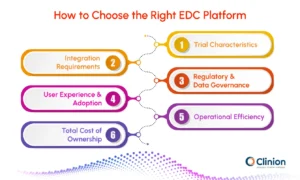
1. Trial Characteristics
- Phase & Size: Enterprise platforms excel in large Phase III/IV trials, while flexible solutions work well for early-phase or investigator-initiated studies
- Therapeutic Area: Oncology and CNS trials with complex endpoints may require more sophisticated data capture and analytics
- Geographic Scope: Multi-country trials need robust multilingual support and regional compliance capabilities
2. Integration Requirements
Assess how the EDC will connect with your existing technology ecosystem:
- CTMS and eTMF systems for unified trial management
- Laboratory and imaging data sources for centralized review
- ePRO/eCOA tools for patient-reported outcomes
- Safety databases for adverse event reporting
- Randomization and trial supply management (RTSM)
Unified platforms reduce reconciliation overhead, while best-of-breed approaches offer flexibility at the cost of integration complexity.
3. Regulatory & Data Governance
All platforms should meet baseline compliance standards (21 CFR Part 11, ICH-GCP), but additional considerations include:
- Regional privacy requirements (GDPR, HIPAA, local data residency laws)
- Audit trail completeness and data lineage tracking
- Validation documentation and ongoing compliance support
- Electronic signature capabilities
4. User Experience & Adoption
Platform usability directly impacts data quality and timeline adherence:
- Site user training requirements and learning curve
- Mobile and offline data entry capabilities for decentralized trials
- Self-service study build tools for rapid deployment
- Quality of vendor support and training resources
5. Operational Efficiency
Consider how the platform impacts your team's productivity:
- Study build and amendment turnaround time
- Real-time data monitoring and query management workflows
- Reporting and analytics capabilities
- Scalability for portfolio growth
6. Total Cost of Ownership
While specific pricing wasn't included in this analysis, evaluate the full financial picture:
- Implementation and validation costs
- Ongoing licensing and per-patient fees
- Internal resource requirements for maintenance and support
- Hidden costs from manual workarounds or integration gaps
Key Questions to Ask During EDC Vendor Evaluations
When speaking with EDC vendors, use these questions to guide your assessment:
Study Build & Configuration:
- How long does a typical study build take from protocol to go-live?
- Can we handle protocol amendments without system downtime?
- What level of technical expertise is required to build and maintain studies?
Data Quality & Monitoring:
- What real-time data quality checks are available during data entry?
- How does the platform support risk-based monitoring strategies?
- What analytics and reporting tools are built in versus requiring third-party integration?
Integration & Interoperability:
- Which systems does your EDC natively integrate with?
- What APIs are available for custom integrations?
- How do you handle data transfers for regulatory submissions?
Site Experience:
- What training is required for site staff?
- How does the platform perform in low-bandwidth or offline environments?
- What mobile and tablet support is available?
Compliance & Validation:
- What compliance documentation do you provide?
- How are system updates handled without impacting validated environments?
- What is your track record with regulatory inspections?
Support & Partnership:
- What level of support is included in standard agreements?
- How responsive is your support team during critical study phases?
- Do you offer strategic consulting for study design optimization?
Conclusion
The EDC landscape in 2026 presents a spectrum of solutions designed to address the complexities of modern clinical trials. Each platform offers distinct capabilities, and selecting the right system requires careful alignment with organizational workflows, trial objectives, and operational strategy. A well-chosen EDC platform not only supports efficient study execution but also reinforces data integrity, operational consistency, and informed decision-making across the trial lifecycle.
External Resources