
- Summary
- How We Evaluated the EDC Systems in This Comparison
- What is EDC software, and what should it do in 2026
- A Comparison: The 10 leading EDC softwares in 2026
- Best EDC Systems by Clinical Trial Use Case
- Decision Framework: How to Choose the Right EDC Software
- Key Questions to Ask During EDC Vendor Evaluations
- Conclusion
- External References
Summary
The EDC market in 2026 is not one-size-fits-all, and the best platform for a given program depends entirely on what that program actually requires. Scale, phase, therapeutic area, and team capacity all shape the decision, and understanding where each platform is genuinely strong is more useful than relying on market rankings alone.
The best EDC platform depends on trial requirements. Medidata Rave, Oracle Clinical One, and Veeva Vault EDC are often selected for large global studies. Viedoc, Castor, and Medrio are popular among organizations prioritizing usability and rapid deployment. Clinion offers AI-enabled workflows and a unified eClinical ecosystem that can help sponsors and CROs accelerate study startup and streamline clinical operations.
How We Evaluated the EDC Systems in This Comparison
Rather than producing a ranked list, our guide compares leading EDC platforms across common evaluation criteria used by sponsors, CROs, and clinical operations teams.
Assessment criteria: | What we assessed |
Compliance baseline | 21 CFR Part 11, ICH-GCP, GDPR/HIPAA coverage |
Study-build speed | Vendor-stated and G2/Capterra-reported go-live timelines |
Ecosystem integrations | Native vs. API-dependent connections to CTMS, RTSM, ePRO, eTMF, safety DBs |
Pricing model | Per-patient / per-study / subscription; open-source availability |
Site usability | Training overhead, offline/mobile support, multilingual capability |
Trial complexity ceiling | Phase range, adaptive design support, multi-country readiness |
What is EDC software, and what should it do in 2026
An Electronic Data Capture (EDC) platform is a software system used to collect, manage, validate, and review clinical trial data electronically. It replaces traditional paper-based data collection methods and serves as the central repository for study data throughout the clinical trial lifecycle.
In 2026, a credible EDC platform should do more than collect data. Sponsors and CROs now expect:
- Real-time data quality checks at the point of entry, not post-collection
- Risk-based monitoring (RBM) dashboards that surface site-level anomalies automatically
- Decentralized trial (DCT) support through native ePRO and eConsent modules
- Regulatory-ready audit trails that survive inspection without manual reconstruction
- Open API connectivity to CTMS, RTSM, safety databases, and biostatistics pipelines
Platforms that deliver only core form collection are increasingly being displaced by integrated eClinical suites or replaced by purpose-built tools for specific trial types.
A Comparison: The 10 leading EDC softwares in 2026
The EDC landscape in 2026 includes a mix of enterprise platforms and flexible, study-focused solutions. The section below presents ten leading global EDC platforms listed in alphabetical order, offering a practical view of how each supports modern clinical trial operations.
EDC Platform | Best For | Deployment Model | Key Modules | Compliance | Pricing Model | Study-Build Time |
Early-phase, adaptive trials | Cloud / SaaS | EDC, RBM dashboards, offline HTML5 forms | 21 CFR Pt 11, ICH-GCP | Per study / per patient | 2–4 weeks (vendor-stated) | |
Academic, decentralized studies | Cloud / SaaS | EDC, eConsent, ePRO | 21 CFR Pt 11, HIPAA, GDPR | Per study / tiered | Days to 1–2 weeks | |
Modular, evolving scope | Private cloud | EDC, Captivate Coder, RTSM, ePRO | 21 CFR Pt 11, GDPR | Open-source core; module add-ons | 2–4 weeks | |
Fast-startup teams, AI-enabled workflows | Cloud / SaaS | EDC, CTMS, RTSM, ePRO, eConsent | 21 CFR Pt 11, ICH-GCP, GDPR | Per study / SaaS subscription | 1-3 weeks (codeless build; verify with vendor) | |
Small–mid biotech, device studies | Cloud / SaaS | EDC, eCOA, hybrid trial support | 21 CFR Pt 11, ICH-GCP | Per patient / modular | 2–3 weeks | |
Large global Phase II–IV trials | Cloud (Medidata Clinical Cloud) | EDC, eConsent, eCOA, RTSM, safety | 21 CFR Pt 11, HIPAA, GDPR, ICH-GCP | Enterprise contract | 4–8 weeks (complex builds) | |
Academic, IT-supported teams | Self-hosted (open source) | EDC, audit trail, monitoring dashboards | Configurable for 21 CFR Pt 11, GCP | Free (hosting + IT overhead) | Variable; IT-dependent | |
Registrational, data-intensive programs | Oracle Cloud | EDC, RTSM, advanced validation | 21 CFR Pt 11, ICH-GCP, global | Enterprise contract | 6–10 weeks (large studies) | |
Veeva-ecosystem sponsors, adaptive designs | Vault Cloud | EDC, CTMS, eTMF, RTSM | 21 CFR Pt 11, GDPR, ICH-GCP | Enterprise contract | 3–5 weeks | |
CROs, multi-country trials | Cloud / SaaS | EDC, eConsent, ePRO/eCOA, logistics | 21 CFR Pt 11, GDPR, HIPAA | Per patient / per study | 1–3 weeks | |
Medical device sponsors and CROs running ISO 14155-aligned studies | Cloud / SaaS | EDC, eCRF design, site and subject management, query management, real-time monitoring dashboards, ePRO/eCOA. | 21 CFR Part 11, ISO 14155, ICH GCP | Per study (contact for quote) | 1-2 weeks |
Note on build times:
Figures above are vendor-stated or drawn from aggregate user reviews. Actual timelines depend heavily on protocol complexity, amendment frequency, and in-house configuration expertise. Validate these numbers directly with vendors during your evaluation.
Best EDC Systems by Clinical Trial Use Case
No single platform leads across every trial type. The right choice depends on the operational demands, regulatory requirements, study complexity, and resource profile of a specific program. While some EDC systems are optimized for large multinational studies, others are designed for decentralized trials, rapid study startup, adaptive protocols, or budget-conscious research environments.
The sections below highlight where leading EDC platforms are most commonly evaluated and the factors that typically influence those decisions.
Large Global Trials
Platforms most commonly evaluated: Medidata Rave, Oracle Clinical One, Veeva Vault EDC
Large multinational studies involve hundreds of sites, multiple languages, complex visit schedules, and extensive regulatory oversight. Sponsors operating in these environments typically prioritize scalability, data consistency, ecosystem maturity, and integration across the broader clinical technology stack.
Medidata Rave remains one of the most widely adopted EDC platforms for large global programs, supported by deep integration across the Medidata Clinical Cloud and a large network of trained site users.
Oracle Clinical One is often selected when integrated randomization and trial supply management (RTSM) are critical to study execution, particularly in registrational programs where data integrity and supply logistics are tightly linked.
Veeva Vault EDC is frequently evaluated by organizations already standardized on Vault CTMS and eTMF, providing a connected ecosystem and support for complex study amendments.
Clinion, Viedoc, and Medrio can also support multinational studies, but are often evaluated by organizations seeking a balance between global capability, implementation speed, operational simplicity, and cost efficiency.
Fast Study Startup
Platforms commonly evaluated: Clinion, Viedoc, Medrio
Reducing study startup timelines remains a priority for sponsors and CROs looking to accelerate enrollment and shorten development cycles. The platforms that perform well here typically offer reusable CDASH-compliant libraries, no-code or low-code configuration, and streamlined deployment workflows that reduce dependency on technical resources.
Clinion, Viedoc, and Medrio are frequently considered by teams optimizing for faster implementation. Key factors to assess include study build speed for protocols comparable to yours, how the platform handles mid-study amendments, the training required for site staff, and the level of internal expertise needed to maintain studies over time. When evaluating build-time claims, ask vendors for reference examples at your specific protocol complexity; timelines vary significantly depending on form count, logic depth, and amendment frequency.
Decentralized and Hybrid Trials
Platforms most commonly evaluated: Castor EDC, Viedoc, Clinion
Decentralized and hybrid trial models require strong support for remote participation, patient-reported outcomes, and flexible site operations. Platforms in this category are typically evaluated for mobile accessibility, eConsent capabilities, ePRO integration, offline data entry, and remote monitoring workflows.
Castor EDC was built from the ground up for remote and investigator-led data collection, making it a natural fit for DCT-first designs. Viedoc offers strong multilingual support and integrated ePRO/eCOA for multi-country hybrid models. Clinion provides unified ePRO and eConsent modules within the same platform, rather than relying on third-party connectors.
Organizations running hybrid trials should also assess how well each platform integrates with patient engagement tools and centralized monitoring systems already in their technology stack.
Early-Phase and Adaptive Trials
Platforms most commonly evaluated: Anju TrialMaster, Castor EDC, Medrio, Clinion
Phase I/II studies require protocol flexibility, rapid amendment turnaround, and the ability to handle intensive or high-frequency data collection without disrupting ongoing study operations. Platforms that perform well here offer configurable CRF architectures, adaptive workflow support, and streamlined RBM dashboards.
Anju TrialMaster is purpose-built for adaptive designs, with flexible CRF libraries, offline-capable forms, and real-time monitoring dashboards suited to early-phase complexity. Castor is increasingly used for investigator-initiated Phase I work where operational simplicity and fast activation matter. Medrio is a strong fit for early-phase device studies where lean operations and high site adoption are priorities. Clinion is worth evaluating for early-phase programs where fast study build and AI-assisted data review are priorities - the codeless configuration and automated discrepancy detection can reduce operational overhead on studies with high data collection frequency.
Budget-Conscious and Academic Programs
Platforms most commonly evaluated: OpenClinica Community Edition, Castor EDC, ClinCapture
For investigator-initiated research, grant-funded studies, or teams with limited EDC budgets, the cost of entry is a primary constraint alongside capability. OpenClinica Community Edition is the only fully open-source option in this comparison. It requires internal IT support for hosting and validation, but carries no licensing fees, making it widely used in academic and non-commercial programs. Castor EDC offers per-study tiered pricing that scales well for smaller trials. ClinCapture's open-source core can be extended modularly over time, which allows organizations to limit upfront commitment while retaining the option to grow.
Clinion is worth considering for budget-conscious teams that still want a fully commercial, validated platform. Its per-study pricing and fast setup make it more accessible than enterprise-tier options, without the IT overhead that open-source alternatives require.
AI-Driven Clinical Data Management
Platforms most commonly evaluated: Clinion, Medidata Rave
Artificial intelligence is becoming a meaningful differentiator in clinical data management. AI-enabled workflows can automate data review, medical coding, reporting, and other tasks that have historically required significant manual effort from data management teams.
Clinion has incorporated AI across multiple areas of the trial lifecycle, including automated medical coding, discrepancy detection, natural language data review via CliniBot, GenAI-assisted reporting, protocol drafting, and CSR generation. The platform also includes agentic AI capabilities, where multiple AI agents work in coordination across clinical data management workflows, moving beyond single-task automation toward connected, multi-step execution.
Medidata Rave offers AI-assisted analytics and query automation through Clinical Data Studio. Both platforms have moved beyond simple edit checks toward workflow automation and anomaly detection, though the architectural approach differs - Clinion's is built as an AI-native layer across the full trial lifecycle, while Medidata's is integrated into an established enterprise data environment.
Medical device clinical trials
Platforms commonly evaluated: Greenlight Guru Clinical
Greenlight Guru Clinical is purpose-built for medical device trials, aligned to ISO 14155 and 21 CFR Part 11 from the ground up instead of adapted from pharma. It gives device sponsors full data ownership with no CRO lock-in, plus real-time dashboards for protocol deviations and data quality throughout the study.
Clinion vs Medidata Rave EDC Comparison
Compare Clinion EDC and Medidata Rave EDC across study setup, data management, AI capabilities, integrations, usability, scalability, and clinical trial workflow fit.
AI EDC Platforms Compared for Clinical Trials
Compare how leading EDC platforms use AI across study setup, data review, coding, source-data extraction, reporting, query management, and human oversight.
Decision Framework: How to Choose the Right EDC Software
Selecting an EDC system requires careful evaluation across multiple dimensions. Consider these key factors:
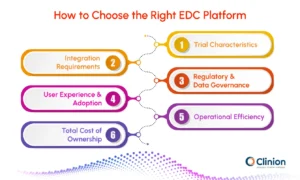
1. Start with trial characteristics, not brand recognition
The right EDC for a 3,000-patient Phase III oncology study is almost certainly wrong for a 60-patient Phase I adaptive trial. Define your requirements first:
Phase and size:
Enterprise platforms justify their complexity at scale; lean platforms deliver faster value for smaller studies
Therapeutic area:
Oncology and CNS trials with complex endpoints and long follow-up need more sophisticated validation and reporting
Geographic scope:
Multi-country trials need robust multilingual interfaces and regional data residency compliance
2. Map your integration requirements before you evaluate vendors
List every system the EDC will need to connect to: CTMS, eTMF, laboratory systems, imaging platforms, ePRO/eCOA tools, safety databases, and RTSM. Then ask each vendor whether each connection is native (built in) or API-dependent (requires configuration). Native integrations reduce reconciliation overhead significantly; API-dependent connections add cost and validation time.
3. Verify compliance for your specific geographies
All platforms reviewed here meet the baseline (21 CFR Part 11, ICH-GCP). The differences appear at the regional level: GDPR data residency, Japan PMDA requirements, China NMPA, and others. If your protocol covers sites in restricted jurisdictions, confirm explicitly and don't assume.
4. Weight site usability appropriately
Poor site adoption is one of the most common causes of data quality problems and timeline slippage. During your evaluation, have site staff (not just sponsors) pilot each platform. Evaluate:
- Time to first productive data entry without formal training
- Mobile and offline functionality
- Language availability for the site's primary language
5. Calculate the total cost of ownership and not just license fees
Licensing is visible; implementation, validation documentation, amendment overhead, and integration development are not. Build a realistic TCO model that includes:
- Implementation and validation costs
- Ongoing per-patient or per-study fees
- Internal resource time for study build and maintenance
- Cost of manual workarounds if integration gaps exist
How to Choose the Right EDC Software for Clinical Trials
Use this buyer guide to evaluate EDC software features, compliance requirements, integrations, data quality workflows, vendor capabilities, and implementation factors before selecting a clinical trial data capture platform.
Key Questions to Ask During EDC Vendor Evaluations
When speaking with EDC vendors, use these questions to guide your assessment:
Study Build & Configuration:
- How long does a typical study build take from protocol to go-live?
- Can we handle protocol amendments without system downtime?
- What level of technical expertise is required to build and maintain studies?
Data Quality & Monitoring:
- What real-time data quality checks are available during data entry?
- How does the platform support risk-based monitoring strategies?
- What analytics and reporting tools are built in versus requiring third-party integration?
Integration & Interoperability:
- Which systems does your EDC natively integrate with?
- What APIs are available for custom integrations?
- How do you handle data transfers for regulatory submissions?
Site Experience:
- What training is required for site staff?
- How does the platform perform in low-bandwidth or offline environments?
- What mobile and tablet support is available?
Compliance & Validation:
- What compliance documentation do you provide?
- How are system updates handled without impacting validated environments?
- What is your track record with regulatory inspections?
Support & Partnership:
- What level of support is included in standard agreements?
- How responsive is your support team during critical study phases?
- Do you offer strategic consulting for study design optimization?
EDC System Migration: A Practical Guide for Clinical Teams
Learn how clinical teams can plan, validate, and execute EDC system migration while protecting data integrity, maintaining study continuity, reducing migration risk, and supporting inspection-ready documentation.
Conclusion
The EDC landscape in 2026 presents a spectrum of solutions designed to address the complexities of modern clinical trials. Each platform offers distinct capabilities, and selecting the right system requires careful alignment with organizational workflows, trial objectives, and operational strategy. A well-chosen EDC software not only supports efficient study execution but also reinforces data integrity, operational consistency, and informed decision-making across the trial lifecycle.
Ready to Explore EDC Solutions for Your Trials?
Discover how Clinion EDC helps teams accelerate study build, streamline data capture, improve data quality, and maintain audit-ready compliance across clinical trials.
External References
10 Leading Electronic Data Capture Systems Companies Shaping the Market to 2030
Electronic Data Capture Systems Companies
Top Electronic Data Capture (EDC) Systems for Clinical Trials in 2025 – Full Comparison Guide
Best Electronic Data Capture (EDC) Software: User Reviews from June 2026
Compare Medidata Rave vs. Medrio EDC | G2